
Stainless steel flanges are critical pipe connection components. Learn about WN, SO, BL, LJ, SW, TH flanges, their pros, cons and applications for oil & gas, chemical, water treatment, food & pharmaceutical industries, helping you select flanges correctly.
Types of Stainless Steel Flanges and Their Applications
Flanges are essential components for connection, disassembly and maintenance in piping systems. Thanks to excellent corrosion resistance, mechanical strength and sanitary performance, stainless steel flanges are widely used in chemical, oil & gas, seawater desalination, food & pharmaceutical, power and other industries. Many purchasers and engineers get confused by different flange types. Wrong selection may lead to leakage, fatigue cracking and unnecessary cost loss. Below we introduce the six most common stainless steel flanges, including structural features, advantages, disadvantages and typical application scenarios.
1. Weld Neck Flange (WN Flange)
The weld neck flange comes with a tapered hub. It is butt-welded with pipes, and the weld seam can be inspected by X-ray. It features uniform stress distribution and great fatigue resistance, suitable for high-pressure, high-temperature and temperature cycling harsh working conditions.
✅ Advantages: Good stress distribution, stable sealing performance, suitable for pipelines with hazardous media, welds available for non-destructive testing
❌ Disadvantages: Higher cost, strict welding requirements and longer installation time
Typical Applications: Oil & gas exploration and refining, high-temperature steam pipelines in power plants, high-pressure chemical process pipelines, offshore platforms, corrosive pipelines made of duplex steel and nickel alloy. It is the preferred flange for critical process pipelines.
2. Slip-On Flange (SO Flange)
The slip-on flange slips over the pipe and is fixed by fillet welds on both inner and outer sides. It is easy to align during installation and has low processing cost, which is the most widely used flange for low-pressure conditions.
✅ Advantages: Easy installation, simple alignment, fast delivery and cost-effective
❌ Disadvantages: Lower fatigue strength than weld neck flanges, not suitable for severe temperature cycling or pipelines with hazardous media under high pressure
Typical Applications: Water treatment, circulating water, general water supply & drainage, ventilation pipelines, low-pressure food pipelines and auxiliary pipelines for common chemical processes.
3. Blind Flange (BL Flange)
Also known as blank flange, this solid flange is used to block pipe ends and isolate pipe sections. It is commonly used for pressure testing, maintenance isolation and reserved interfaces for future pipeline expansion.
✅ Advantages: Reliable sealing, easy disassembly, compatible with all pressure classes
❌ Disadvantages: Only for blocking instead of connecting pipelines; sediment corrosion may occur on the end face when corrosive media stay static for a long time
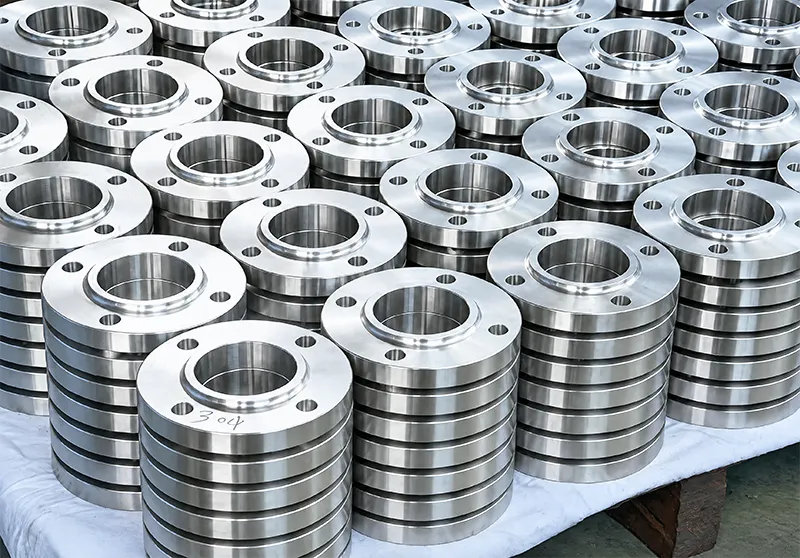
Typical Applications: Pipeline pressure testing, spare ports of equipment, end sealing of pipelines, isolation for valve maintenance, port sealing for oil & gas, chemical industry and pressure vessels. (This is exactly the product shown in your picture)
4. Lap Joint Flange (LJ Flange)
The flange disc can rotate freely, matched with a stub end. The flange itself can be carbon steel while the stub end is stainless steel, which greatly reduces the cost of high-alloy projects. It is convenient for bolt alignment and frequent disassembly & maintenance.
✅ Advantages: Easy bolt hole alignment, suitable for repeated disassembly, saving cost of expensive alloy materials
❌ Disadvantages: Not suitable for impact conditions or high-pressure alternating working conditions
Typical Applications: Corrosive chemical pipelines, large-diameter pipelines, food & pharmaceutical pipelines requiring frequent disassembly and cleaning, seawater desalination projects.
5. Socket Weld Flange (SW Flange)
The pipe is inserted into the socket of the flange and fixed by fillet welding. It is mostly used for small-bore pipelines with compact structure.
✅ Advantages: Firm connection, accurate positioning and small space occupation
❌ Disadvantages: Medium is easy to accumulate at the bottom of the socket, causing crevice corrosion. Not suitable for strong corrosion or frequent thermal cycling scenarios
Typical Applications: Instrument small-bore pipelines, high-pressure small-bore steam pipelines in power plants, small high-pressure branch pipelines in chemical industry.
6. Threaded Flange (TH Flange)
It is connected by internal and external threads without welding, ideal for sites where hot work is forbidden.
✅ Advantages: Welding-free, quick installation, the first choice for sites with welding restriction
❌ Disadvantages: Threads are prone to leakage, not suitable for high-temperature and strong corrosive media
Typical Applications: Low-pressure gas pipelines, instrument air pipelines, partial fire protection pipelines and renovation sites where welding is not allowed.
Extra Note: Flange Face Types for Selection
For the same flange type, there are different sealing faces: RF (Raised Face, most common), FF (Full Face), MFM (Male & Female Face), TG (Tongue & Groove Face), RTJ (Ring Type Joint, metal ring sealing for high-pressure oil & gas service). The sealing face must match the gasket.
Stainless Steel Material Matching for Different Working Conditions
- 304: General service, clean water, normal air, low-pressure food pipelines
- 316 / 316L: Chloride-containing environment, seawater, weak acid chemical service, better corrosion resistance than 304
- 2205 / 2507 Duplex Steel: High chloride environment, seawater desalination, desulfurization, corrosive oil & gas service, good resistance to pitting corrosion and stress corrosion cracking
- Hastelloy, Monel: Special chemical service with strong corrosion
Quick Selection Summary
- High temperature & high pressure, hazardous media → Weld Neck Flange (WN)
- Low pressure general service, budget priority → Slip-On Flange (SO)
- Pipeline blocking, pressure test & reserved ports → Blind Flange (BL)
- Frequent disassembly, high alloy cost control → Lap Joint Flange (LJ)
- Small bore high-pressure, instrument pipelines → Socket Weld Flange (SW)
- Hot work is not permitted on site → Threaded Flange (TH)
Conclusion
When selecting flanges, you should not only check dimensions and pressure class, but also consider medium corrosivity, temperature fluctuation, disassembly frequency and welding permission.
We manufacture a full range of stainless steel flanges in 304, 316L, 2205, 2507 and other grades complying with ANSI B16.5, DIN and other standards.
Custom drawings, precision machining and strict quality inspection are available.
Feel free to contact us for flange quotation or customized drawing requirements.