
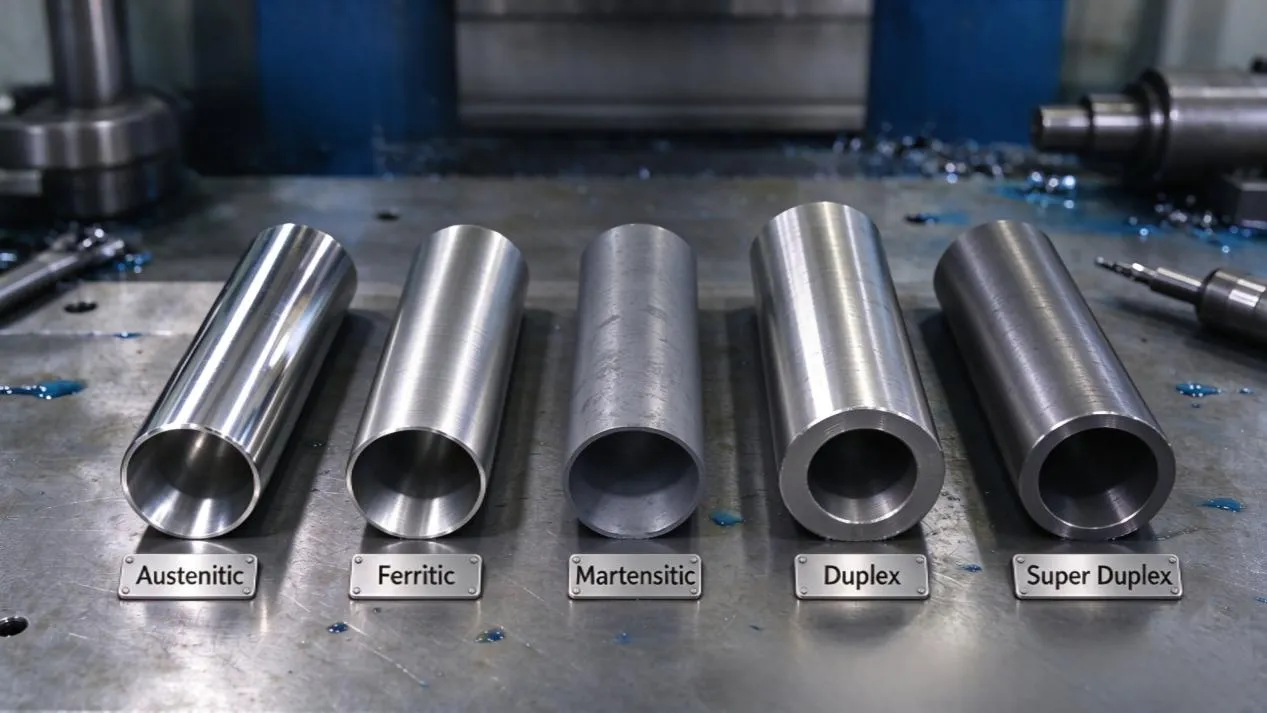
Stainless steel pipe is widely used in oil & gas, chemical processing, food & pharmaceutical, desalination and water treatment industries. Not all stainless steel performs the same. Their corrosion resistance, mechanical strength, weldability and temperature tolerance are determined by their metallurgical families and alloy composition.
This guide breaks down the five major families of stainless steel pipe grades, lists typical grades, chemical composition, advantages, limitations and service scenarios. We also provide scenario-based selection guidance to help engineers and procurement buyers make correct material selection.
The 5 Families of Stainless Steel Pipe Grades
Stainless steel contains a minimum of 10.5% chromium to form a passive anti-corrosion oxide layer. Based on its internal microstructure, industrial stainless steel pipe is grouped into five core families:
- Austenitic stainless steel
- Ferritic stainless steel
- Martensitic stainless steel
- Duplex stainless steel
- Super duplex stainless steel
Each family has unique nickel, chromium, molybdenum and nitrogen ratios. There is no universal “best” grade. The correct selection balances process conditions, corrosion risk, temperature, pressure and project budget.
Austenitic Stainless Steel Pipe Grades
Austenitic stainless steel is the most popular and versatile piping material on the market. It features an austenitic grain structure at room temperature.
1.Key features: Non-magnetic, excellent toughness, easy forming and welding, outstanding low-temperature performance
2.Limitation: Moderate mechanical strength; risk of intergranular corrosion if carbon content is not controlled
3.Common grades: 304, 304L, 316, 316L, 321, 310S
- 304 / 304L: General-purpose grade for clean water, food and hygienic pipelines
- 316 / 316L: Molybdenum added, better chloride resistance for pharmaceutical and chemical service
- 321: Titanium-stabilized grade, designed for continuous high-temperature service 400–600℃
- 310S: High chromium & nickel, excellent oxidation resistance for high-temperature furnace piping
4.Typical applications: Food & beverage, pharmaceutical sanitary piping, purified water, general chemical lines, heat exchangers.
Ferritic Stainless Steel Pipe Grades
Ferritic stainless steel has little or no nickel and is magnetic. Its microstructure is ferritic.
- Key features: Cost-effective, good resistance to stress corrosion cracking, high thermal conductivity, low thermal expansion
- Limitation: Poor low-temperature toughness; welding brittleness, not suitable for heavy welding
- Common grades: 430, 439, 444
- Typical applications: Hot water piping, condensers, exhaust systems, decorative pipes. Not recommended for high-pressure, low-temperature or severe chloride environments.
Martensitic Stainless Steel Pipe Grades
Martensitic stainless steel can be hardened and strengthened by quenching and tempering heat treatment. It is magnetic.
- Key features: High hardness, great wear resistance
- Limitation: Relatively poor corrosion resistance, high welding cracking risk; post-weld heat treatment required
- Common grades: 410, 420, 431
- Typical applications: Mostly used for valve stems, pump shafts and mechanical components. Rarely selected for general process fluid transmission pipelines.
Duplex Stainless Steel Pipe Grades
Duplex stainless steel consists of roughly 50% austenite + 50% ferrite dual-phase microstructure. The most widely used grade is 2205 (UNS S32205).
- Key features: Much higher strength than 316L, excellent resistance to pitting, crevice corrosion and chloride-induced stress corrosion cracking
- Limitation: Higher cost than standard austenitic stainless steel; fabrication and welding procedures must be strictly followed
- Typical applications: Desalination, flue gas desulfurization, offshore piping, oil & gas service with moderate chloride content.
Super Duplex Stainless Steel Pipe Grades
Super duplex upgrades standard duplex with higher chromium, molybdenum and nitrogen content. The representative grade is 2507 (UNS S32750).
- Key features: Industry-leading chloride pitting resistance, ultra-high mechanical strength for harsh corrosive media
- Limitation: Premium price; not suitable for long-term service above 300℃ where performance degrades
- Typical applications: Offshore platforms, sour oil & gas wells, brine handling, hydrometallurgy and aggressive chemical processes.
How to Select the Right Stainless Steel Pipe According to Application Scenarios
There is no universal stainless steel grade that works for all piping systems. The best choice depends on your actual service scenario: corrosive medium, chloride content, operating temperature, design pressure, sanitary requirements and budget. Below we sort common industrial scenarios and match the recommended stainless steel pipe grades for you.
① Food, Beverage & Pharmaceutical Sanitary Pipeline
Key requirements: Smooth internal surface, cleanability, low contamination risk, compliance with GMP / ASME BPE, good weldability.
- Recommended: 304L, 316L
- Notes: 316L is preferred if there is saline, brine or cleaning agents with chloride. Super duplex is unnecessary here and over-costly.
- Avoid: Martensitic, ferritic grades (hard to polish, poor corrosion stability for frequent cleaning).
② Pure Water, Drinking Water & General Domestic Water
Key requirements: Anti-rust, low cost, stable performance under room temperature.
- Recommended: 304L
- Notes: If the water source is brackish water with high chloride, upgrade to 316L.
③ General Chemical Process (Weak acid, non-chloride medium)
Key requirements: General corrosion resistance, easy fabrication and welding.
- Recommended: 304L
- Notes: Once chloride, halogen or strong acid exists, switch to 316L or duplex steel.
④ Chemical, Cooling Water with Chloride / Brackish Water
Key requirements: Resist pitting corrosion caused by chloride ions.
- Recommended: 316L for low chloride; 2205 for medium chloride.
- Notes: 316L contains molybdenum for basic chloride resistance, but it fails under high chloride concentration.
⑤ Seawater, Desalination, Flue Gas Desulfurization (FGD)
Key requirements: Excellent resistance to high chloride, crevice corrosion and stress corrosion cracking.
- Recommended: 2205 (standard choice); 2507 for extreme seawater / brine environment.
- Notes: Ordinary 316L will suffer severe pitting quickly in seawater service.
⑥ Oil & Gas Industry
- Non-sour, moderate chloride well: 2205
- Sour wells, high chloride & H₂S environment: 2507 Super Duplex
- High-temperature dry gas without chloride: 310S
⑦ High-temperature Furnace, Heat Treatment Pipeline
Key requirements: Resist high-temperature oxidation.
- Recommended: 310S
- Notes: Duplex and super duplex cannot be used for long-term service above 300°C.
⑧ Low-temperature / Cryogenic Service
Key requirements: Keep good toughness under low temperature.
- Recommended: Austenitic grades (304L, 316L)
- Avoid: Ferritic and martensitic steels, they become brittle at low temperatures.
⑨ Hot Water, Condenser & Exhaust System
Key requirements: Low cost, good thermal conductivity.
- Recommended: 430 ferritic stainless steel
- Notes: Not suitable for thick welding, high pressure or chloride-rich water.
⑩ Mechanical parts, valve stems, pump shafts (not for fluid delivery)
Key requirements: High hardness and wear resistance.
- Recommended: 410 martensitic stainless steel
- Notes: Poor corrosion resistance; not suitable as process transmission piping.
Quick Selection Cheat Sheet
| Application Scenario | Suggested Grade |
| Food & pharmaceutical sanitary line | 304L / 316L |
| Pure drinking water | 304L |
| General chemical without chloride | 304L |
| Cooling water / mild chloride medium | 316L |
| Desalination, FGD, moderate chloride seawater | 2205 |
| Offshore platform, sour oil well, high chloride brine | 2507 |
| High-temperature furnace piping | 310S |
| Cryogenic low-temperature pipeline | 304L / 316L |
| Hot water, condenser, exhaust | 430 |
| Valve stem, wear mechanical component | 410 |
Conclusion
The five stainless steel families are separated by their internal microstructure, which defines their working boundaries. Austenitic stainless steel remains the safe, mainstream option for most industrial piping. When chloride and corrosion severity rise, upgrade to duplex or super duplex grades. Ferritic and martensitic grades only fit narrow, specific conditions.
When you source seamless or welded stainless pipes, flanges and fittings, always confirm medium, temperature and pressure first before locking the grade, rather than comparing prices blindly. Proper stainless steel grade selection guarantees long-term safety and reliability for your piping system.